
After two years of strong gains, smallcap stocks fell sharply in 2025, but the correction may be setting up opportunities for long-term investors.

Equity benchmark indices Sensex and Nifty experienced a significant decline, primarily driven by a selloff in IT stocks due to concerns about AI disruption and renewed worries over global trade.

Unless the primary market momentum slows, smallcap stocks will stay subdued.

Equity trading volumes, both in the cash and derivatives segments, dropped in March amid wild swings in stock prices. The average daily trading volume for the cash segment (National Stock Exchange, or NSE, and BSE combined) fell by 16.3 per cent to Rs 1.07 trillion - the lowest since November 2023. Market players said the drop could have been sharper if not for the large block deals in companies such as ITC, Tata Consultancy Services, and IndiGo seen during the month.

The recent selloff in the Indian equity market has been far more painful for mid and smallcap stocks compared to largecap stocks. The benchmark BSE Sensex is now down 9.5 per cent from its record monthly closing of 84,300 at the end of September last year. In the same period, the BSE MidCap has lost 17 per cent of its value, while the BSE SmallCap has corrected by 17.1 per cent.
Indian equities on Dalal Street saw volatility as global market trends and fresh tariff concerns linked to Donald Trump impacted investor sentiment. Track Sensex, Nifty50 movement and key market drivers for Feb 24, 2026.

The BSE Sensex plummeted 1,236 points, wiping out nearly Rs 7 lakh crore in investor wealth, driven by escalating tensions between the US and Iran and subsequent market selloff.

'Retail portfolios were going nowhere even as headline indices moved higher, prompting investors to sell holdings and shift money to IPOs, attracted by listing-day gains.'
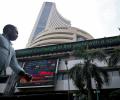
Benchmark stock indices Sensex and Nifty closed on a flat note in a choppy session on Wednesday as gains in PSU banks and auto shares were offset by losses in IT stocks.

The 2025 contraction marks the steepest decline in both the number of billionaire promoters and their aggregate wealth since 2012.

Among the 11 equity sub-categories, thematic funds received the highest net inflows at Rs 9,017 crore, followed by smallcap funds at Rs 5,721 crore and flexicap funds at Rs 5,698 crore.

In January, SIP account closures surpassed new registrations for the first time.

It has mostly been a one-way street for smallcap stocks that have taken it on their chin thus far in February. The Nifty Smallcap 250 index has shed 3.2 per cent in the current month as compared to the 1.8 per cent decline in the Nifty Midcap 100 and the 0.5 per cent drop in the Nifty 50 index, data showed. Technically, the index has slipped below its 20-day moving average (DMA) placed at 14,800 levels on Monday, and is currently testing the 50-DMA, and is placed at 14,278 levels.

All sectoral indices ended lower. BSE Telecommunication tanked 2.18 per cent, metal (1.77 per cent), auto (1.70 per cent), energy (1.64 per cent), oil & gas (1.59 per cent), commodities (1.39 per cent) and financial services (1.37 per cent) were the major laggards.

Market players attribute the rally in small and midcaps to flows from retail investors and domestic institutions.

Tata Steel was the biggest loser in the Sensex pack, sliding 8.59 per cent, followed by Tata Motors, Larsen & Toubro, Adani Ports, IndusInd Bank, Tech Mahindra, Reliance Industries, Sun Pharmaceutical, HCL Technologies, Tata Consultancy Services, Infosys, and NTPC, were the major laggards. On the other hand, Bajaj Finance, HDFC Bank, Nestle India, ICICI Bank, ITC, Asian Paints and Axis Bank were among the gainers.
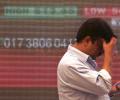
Investors' wealth eroded by Rs 5.98 lakh crore on Thursday, tracking weak trends in equities where the BSE Sensex tumbled 1 per cent. Benchmark indices Sensex and Nifty declined 1 per cent in tandem with weak global market trends amid growing tensions in the Middle East.

Global fund managers witnessed one of their largest-ever declines in assets under custody (AUC) during the ongoing correction in the Indian markets, as stocks came under pressure from foreign outflows and the weakening rupee.

Small and midcaps are leading the charge in the latest market rebound. Since November 21, when the benchmark S&P BSE Sensex and the National Stock Exchange Nifty hit their recent lows and slipped into correction territory, the Nifty Smallcap 100 index has risen by 8 per cent, while the Nifty Midcap 100 has gained 5.7 per cent. Meanwhile, the Nifty 50 index has risen by 4.7 per cent during this period.

Zomato emerged as the biggest gainer, followed by Reliance, Nestle, Asian Paints and Power Grid.

On average, stocks that debuted last year are down 37 per cent from their peak levels.

'Expect FPIs to continue selling for several months until the rupee stabilises.'

'The market's sharp decline recently has shaken the confidence of retail investors, leading to increased selling.'

Industry players said the sharp sell-off in February forced many companies to put off their listing plans

Investors' wealth on Monday surged Rs 4.21 lakh crore as markets bounced back after five days of fall. The BSE Sensex jumped 602.75 points or 0.76 per cent to settle at 80,005.04. During the day, it surged 1,137.52 points or 1.43 per cent to 80,539.81.

'The economy is clearly at a very soft spot, and earnings growth is disappointing every day.' 'After three great years, the Indian economy has hit a rough patch.'

A little over 2,400 BSE-listed stocks ended with gains in April amid a sharp rebound in the broader markets from the March lows. This was the highest number of stocks that rose during a calendar month, as per data provided on BSE's website. The previous high was 2,322 gainers recorded in January.

Data from Amfi shows that NAV of every one in two BAFs declined 1.5% or less on Monday compared to a 3.13% decline in Nifty 500.

Eighty per cent, or 60 of the 75 companies that made their debut on the mainboard this financial year, ended their listing day with gains.

'On the weekly chart, the Nifty 50 index has formed a bearish candle and remains below all short-term moving averages.'

In addition to regulatory actions against small and midcaps, tighter liquidity conditions are another headwind that stocks are facing this month. Market observers say advance tax outflows and capital gains-related adjustments will weigh on the markets in the near term.

Hong Kong has regained its spot as the world's fourth-largest market following a broad market rout in Indian equities. Currently, the Chinese territory's market capitalisation stands at $4.9 trillion versus India's $4.75 trillion, according to data compiled by Bloomberg. In January, the domestic equity markets' market capitalisation had surpassed that of Hong Kong following a spectacular rally in the small- and midcap stocks.

Overall market reaction to the Budget was neutral. Investors absorbed the changes to the tax rates (positive for salaried class) and capital gains taxes (CGTs, negative due to the removal of indexation and increases. Other proposals largely pertain to supporting rural development, buybacks taxed as dividends, Custom duty changes that impact multiple sectors, higher outlays for clean energy, etc. There's some moderation in the growth of capex outlay across defence, fer

'Those satisfied with returns and not expecting further rally could be booking profits and also stopping SIPs.'

This is a good opportunity for long-term investors to pick quality small and midcap stocks at reasonable valuations.

Brokerages believe that the Bharatiya Janata Party's (BJP's) stronger-than-expected showing in state elections reduces political risks for the domestic markets going into 2024. However, after the short-term excitement, the focus will soon shift to earnings, global liquidity conditions, and the interest rate trajectory. "BJP's win in the three state elections is much better than what exit polls suggested and reinforces the consensus expectations of a Modi win in the 2024 national elections with a greater likelihood of 300+ seats for the BJP.

Investors' wealth has eroded by over Rs 6.15 lakh crore in three days of market decline amid weak global cues and persistent selling by foreign funds. The BSE benchmark Sensex tumbled for the third straight session on Friday to close at 59,306.93, down 677.77 points or 1.13 per cent. In three days, the 30-share index has lost 2,043.33 points or 3.33 per cent.

Investors have lost a hefty Rs 11,45,267.43 crore in two days as the domestic equity market continued to face severe drubbing amid a global selloff. The BSE benchmark Sensex plunged 1,189.73 points or 2.09 per cent to close at 55,822.01 on Monday. During the day, it tanked 1,879.06 points to 55,132.68.

Investors' wealth on Friday tumbled by over Rs 4.65 lakh crore as markets suffered a heavy selloff following weak global trends and continued selling by foreign institutional investors. The 30-share BSE benchmark Sensex plunged 889.40 points or 1.54 per cent to close at 57,011.74. During the day, it tumbled 950.16 points to 56,950.98. The market capitalisation of BSE-listed companies declined by Rs 465,570.82 crore to Rs 2,59,37,277.66 crore amid weak sentiments.
Investors' wealth on Thursday tumbled over Rs 2.81 lakh crore as stocks declined in line with selloff in global equities. The 30-share BSE benchmark index tanked 581.21 points or 1 per cent to settle at 57,276.94. During the day, it cracked 1,418.79 points to 56,439.36. In tandem with weak trend in equities, the market capitalisation of BSE-listed firms tanked Rs 2,81,147.38 crore to Rs 2,59,97,419.48 crore.
 © 2026 Rediff.com - Advertise with us - Disclaimer - Privacy Policy - Sitemap - Feedback - About us - Terms of use - Grievances